
Excerpt from Issue 05
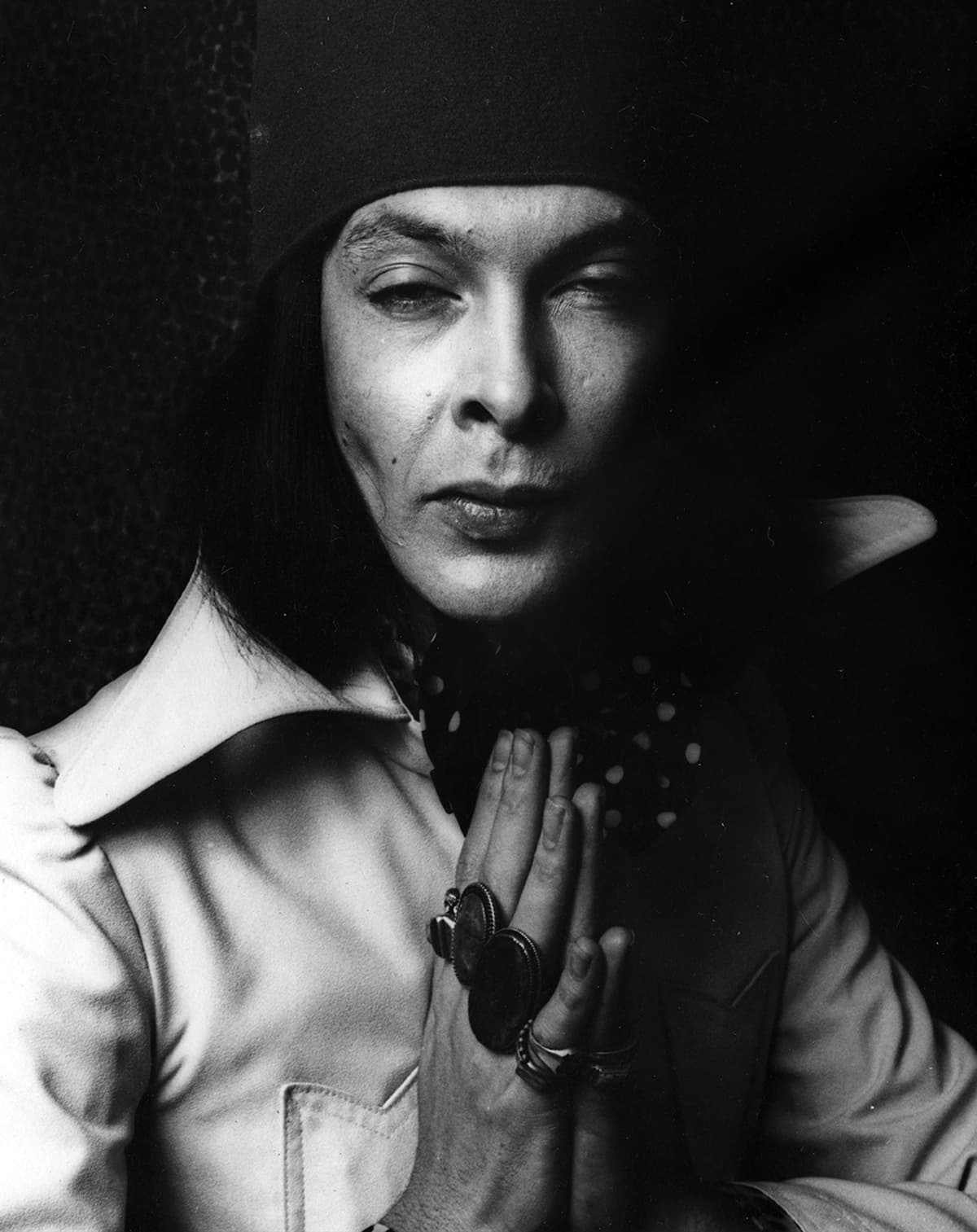
A DIZZY TRIP
Across fashion, performance, and image-making, Steven Arnold embraced glamour as a conduit to healing and transcendence.
Text by Annabel Graham Archival Images Courtesy of Del Vaz Projects © ONE Archives at the USC Libraries
When the artist Steven Arnold was five years old, he discovered a chest of costumes and makeup belonging to an actor uncle in his parents’ attic. Enthralled, he spent hours dressing up. His parents encouraged his love for the fantastical, eventually allowing him to use the attic as a playroom, where he built sets and staged plays for children in their Oakland neighborhood. These formative experiences marked the beginnings of a lifelong fascination with performance, adornment, and the act of inhabiting other selves—concerns that would shape an expansive interdisciplinary practice.
Arnold’s work has long resisted easy categorization. Best known for his 1971 cult film Luminous Procuress and his meticulously-staged photographic tableaux, he moved fluidly between mediums—filmmaking, photography, painting, illustration, set and costume design, assemblage—inhabiting a lush, theatrical visual language informed by Surrealism and queer camp.
Despite his association with major figures like Salvador Dalí—who, after seeing Luminous Procuress, embraced Arnold as a kindred spirit and invited him to Spain to collaborate on projects at the Teatro-Museo Dalí in Figueres—Arnold’s work remained largely outside the mainstream art-historical narrative during his lifetime. (He died of AIDS-related complications in 1994). One significant, lesser-known dimension of his practice unfolded through fashion.
“Glamour was a huge part of Steven’s world,” says Vishnu Dass, Director of the Steven Arnold Archive and of Heavenly Bodies, a 2019 documentary on Arnold’s life and work. “His relationship to fashion was really about theater and illusion.”
As a college student at the San Francisco Art Institute in the early 1960s, Arnold began designing his own clothes, which his mother—a seamstress who had made nearly all of his garments since childhood—would sew for him. He occasionally sold these creations. “Every once in a while,” says Dass, “A pair of velvet bell bottoms with a Steven Arnold tag will show up at a vintage shop in the Bay Area.”
In the early ‘70s, Arnold found a natural community among young San Francisco artists working at the edges of fashion and performance: sculptural couturier Kaisik Wong and neo-tribal jewelers Alex & Lee; all key figures in the city’s emerging wearable art scene. That circle coalesced around Obiko, Sandra Sakata’s pioneering Sutter Street boutique. There, Arnold designed window displays and collaborated with Wong on immersive, themed installations, reimagining the storefront as an ever-evolving stage...
continued on page 124 of Issue 05
SUBSCRIBE NOW
Selected Excerpts from Issue 05
PERPETUAL MOTION
READ MORE
OPEN HOUSE
READ MORE

QUIET ON THE LAND
READ MORE
AMERICAN DREAM
READ MORE