
Excerpt from Issue 04
VANISHING ACT
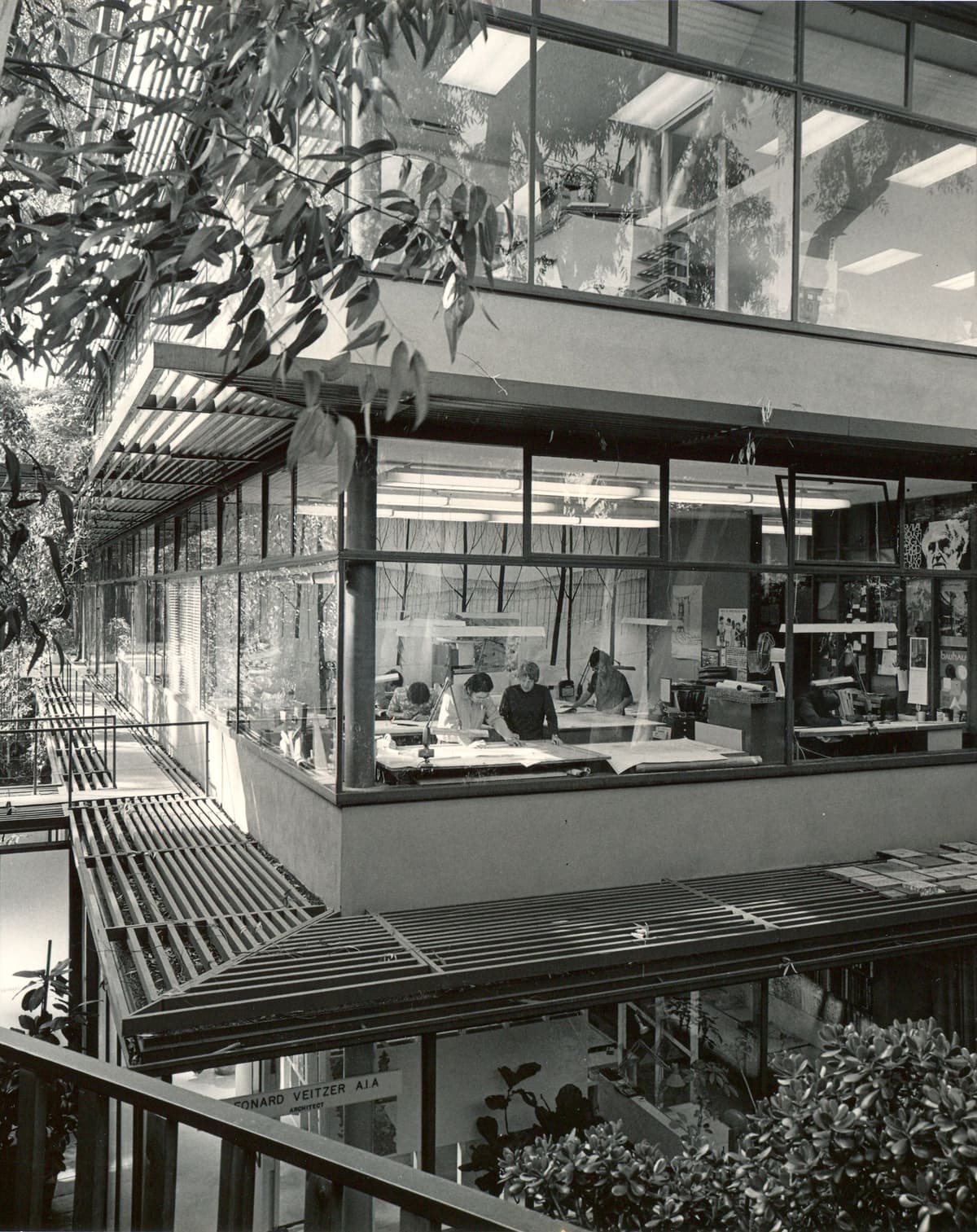
Lloyd Ruocco’s mid-century “Phantom Architecture” resisted spectacle in favor of intimacy and environmental attunement.
Text by JenMarie Landig Archival Photos Courtesy of Todd Pitman / Lloyd Ruocco Archive and The Huntington
The blurring of boundaries between interior and exterior space is hardly unique to San Diego, though it was that city’s foremost mid-century architectural critic, James Britton II, who coined the term “Phantom Architecture” to describe this phenomenon—specifically in relation to the designs of architect Lloyd Ruocco (1907 - 1981). Characterized by the use of reflective glass and post-and-beam construction to evoke spaciousness, Phantom Architecture refers to a style in which buildings blend seamlessly with nature, often seeming to “disappear” into their surroundings.
“You walk into the house, and the first thing you notice is everything other than the house,” says landscape architect and Ruocco archivist Todd Pitman. “You notice the light, the shadows, the trees.” Ruocco structures in particular, he explains, are usually set back from the street; ensconced in mature, planted land. One can often see right through them—the architecture feels transparent and unobtrusive, never imposing. The Bleecker/Burton House aka “Three Wishes House” (1942-9) and Wexler House (1963) are stunning examples of this effect. “If the outdoors is clean, the inside feels clean,” says Derek Roth, current owner of the Bleecker/Burton House.
This approach speaks to a certain architectural humility. Keith York, Agents of Architecture partner and principal of the preservation journal Modern San Diego, calls it Ruocco’s “instinct to follow the land.” For Ruocco, site was just as important as structure—if not more. While many architects cleared trees or blasted granite to impose their buildings, Ruocco integrated his work into the natural landscape. The Wexler House makes this clear: boulders stand beside the carport and at the basement level, untouched, with the house shaped carefully around them. As York observes, “Ruocco put a house where the land told him to.”
For his Design Center (1949), Ruocco chose a serene canyon lined with eucalyptus trees in San Diego’s Hillcrest neighborhood. From 5th Avenue, the deceptively modest structure reads as single-story. Expansive glass panels are framed by redwood beams in Ruocco’s signature style, dissolving the boundary between structure and surroundings. Upon descending the southeast staircase or the sloping driveway behind the building, though, the full three-story wood-and-glass creation comes into view—an arresting, unexpected sight. David McCullough, who leads McCullough Landscape Architects at the Design Center, recalls being struck by the restraint of this design choice, which he contrasts with those of architects who “build giant monoliths to their ego.” Ruocco eschewed spectacle, creating instead a humble, human-scaled connection to the street…
continued on page 38 of Issue 04
SUBSCRIBE NOW
Selected Excerpts from Issue 04

THE SHAPE OF THINGS
READ MORE
HANDS ON
READ MORE

A ROCKET SHIP TO THE SUN
READ MORE

EDGE OF A SUNLIT OBJECT
READ MORE